


A Maryland lease agreement sets the terms for renting a residential property and helps landlords and tenants understand their responsibilities before the arrangement begins. This guide covers Maryland’s statewide lease requirements, including required disclosures and key laws that apply to all rentals in The Free State.
Maryland also has local rental rules, including additional requirements in places like Montgomery County and Baltimore. While this guide does not cover every local ordinance in detail, a Maryland residential lease agreement template can help you create a contract that suits your rental and covers all the essentials.

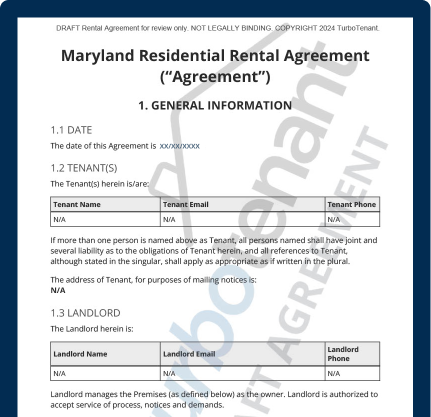
Maryland Residential Lease Agreement
Current PageCreate a compliant Maryland residential lease agreement in 15 minutes with TurboTenant's rental contract builder.
Maryland Month-to-Month Lease Agreement
Learn MoreBuild your Maryland month-to-month lease agreement in 15 minutes.
Room Rental Agreement Maryland
Learn MoreUse a TurboTenant Maryland room rental agreement to legitimize your house hacking endeavors.
Required Landlord Disclosures (8)
Disclosures give tenants important information about the rental before they sign or move in. Maryland law requires landlords to disclose certain details in residential leases, including:
- Lead-based paint: The only federally required disclosure concerns lead-based paint and lead-based paint hazards. Landlords of most units built before 1978 must disclose known hazards before lease signing and give tenants the EPA pamphlet (42 U.S.C. § 4852d).
- Landlord identification: Maryland landlords must include in the written lease or post on the property the name, address, and phone number of the landlord or the person authorized to accept service of process or notice (Md. Code Ann., Real Prop. § 8-210(a)).
- Security deposit receipt: When accepting a security deposit, landlords must provide a written receipt that explains Maryland’s rules for handling and returning the deposit, as well as the tenant’s right to request move-in and move-out inspections (Md. Code Ann., Real Prop. § 8-203(c), § 8-203.1).
- Shared utilities: If a landlord uses a ratio utility billing system for electricity, gas, wastewater and sewage, or water, the landlord must give prospective tenants written notice identifying each utility, the allocation method, recent utility bills, average monthly costs, service or administrative fees, the tenant’s right to inspect records, and a citation to the statute. A lease term requiring ratio utility payments becomes unenforceable without the required disclosures (Md. Code Ann., Real Prop. § 8-212.4(c)).
- Habitability disclosure: The rental agreement must include a statement about whether the property will be available in a condition that permits habitation with reasonable safety. It must also list the landlord’s and tenant’s specific obligations for heat, gas, electricity, water, and repairs (Md. Code Ann., Real Prop. § 8-208(c)(1), § 8-208(c)(2)).
- Maryland Tenants’ Bill of Rights: Landlords must attach the most current version of the Maryland Tenants’ Bill of Rights to every residential lease (Md. Code Ann., Real Prop. § 8-208(c)(4)).
- Mold disclosure: Maryland landlords must provide tenants with the required mold pamphlet when the lease t is signed and ask tenants to acknowledge receipt. The law also sets timelines for assessing and remediating reported mold in rental units (Md. Code Ann., Real Prop. § 8-220).
- Surety bond disclosure: If a tenant purchases a surety bond instead of paying all or part of a security deposit, the surety must provide the tenant with written disclosures before the purchase. The disclosure must explain that the payment is nonrefundable, that the bond does not insure the tenant, that the tenant may still owe unpaid rent or damages, and that the tenant may need to reimburse the surety for amounts paid to the landlord. Landlords should clearly state any accepted surety bond terms in the lease packet (Md. Code Ann., Real Prop. § 8-203).
Security Deposit Regulations
Maximum security deposit amount: Maryland landlords may charge up to 1 month’s rent as a security deposit. A landlord may charge up to 2 months’ rent only if the tenant qualifies for utility assistance through the Department of Human Services, the lease requires the tenant to pay utility services directly to the landlord, and the landlord and tenant agree to the higher security deposit in writing (Md. Code Ann., Real Prop. § 8-203(b)(1), § 8-203(b)(2)).
Receipt of deposit: When accepting a security deposit, Maryland landlords must give tenants a written receipt that notifies them of their move-in and move-out inspection rights, the landlord’s inspection duties, the 45-day deadline for any itemized deductions, the 45-day deadline to return unused deposit funds, and the possible penalty for violating the security deposit law (Md. Code Ann., Real Prop. § 8-203(c)(1), § 8-203.1).
Interest: Maryland landlords must hold security deposits in qualifying interest-bearing accounts and return interest at 1.5% per year or the daily U.S. Treasury yield curve rate for 1 year, whichever is greater (Md. Code Ann., Real Prop. § 8-203(d), § 8-203(e)(1)).
Deduction tracking: If a landlord withholds any portion of a security deposit, they must mail a written list of damages and an itemized statement of costs within 45 days after the tenancy ends. If the landlord uses an estimate, they must later notify the tenant when repairs finish, provide the final invoice, and return any excess withheld amount within 30 days after completing the repairs (Md. Code Ann., Real Prop. § 8-203(f)(1)(i), § 8-203(g)(1)).
Returning a tenant’s security deposit: Landlords must return the security deposit, plus any required interest and less any lawful deductions, within 45 days after the tenancy ends (Md. Code Ann., Real Prop. § 8-203(e)(1)).
Landlord’s Access to Property
Advance notice: Maryland law does not set a statewide notice period for landlord entry. That said, landlords should enter only for reasonable purposes, like repairs, inspections, or emergencies.
Immediate access: Maryland law does not provide detailed statewide rules for emergency entry. Landlords can typically enter without advance notice when an emergency requires immediate access.
Landlord harassment: Maryland landlords must allow tenants to use the rental property peacefully and quietly. Excessive or unreasonable entry could interfere with that right, and tenants may take legal action in serious cases (Md. Code Ann., Real Prop. § 8-204).
Rent Payment Laws
Grace period: Maryland law does not require a grace period for late rent payments.
Late rent fees: The maximum late rent fee in Maryland is 5% of the unpaid rent due for that rental period. For weekly rentals, the late fee cannot exceed $3 per week or $12 per month (Md. Code Ann., Real Prop. § 8-208(d)(3)).
Tenant’s right to withhold rent: Tenants may seek rent escrow when a landlord does not repair serious and dangerous defects within a reasonable time after notice. Tenants usually must pay rent into court to use this remedy (Md. Code Ann., Real Prop. § 8-211(h), § 8-211(k)).
Breach of Rental Agreement
Missed rent payment: Once rent is late, landlords may initiate repossession under Maryland’s failure-to-pay-rent process. Landlords must provide a tenant with at least 10 days’ notice before filing the complaint (Md. Code Ann., Real Prop. § 8-401(c)).
Lease violation: Maryland landlords may deliver a 30-day written notice for a lease violation before filing for repossession. They do not have to give the tenant the option to cure. For breaches that constitute clear and imminent danger, 14 days’ notice may apply (Md. Code Ann., Real Prop. § 8-402.1(a)(1)(i)).
Self-help evictions: Landlords should never attempt illegal self-help evictions. Self-help eviction methods include changing the locks, shutting off utilities, removing a tenant’s belongings, blocking access to the unit, or otherwise forcing the tenant out without a court order.
Lease abandonment: A tenant who breaks a lease early without a qualifying reason may owe rent and damages. Maryland landlords must mitigate damages, but they do not have to show or lease the vacated unit before other available units (Md. Code Ann., Real Prop. § 8-207).
Prohibited lease clauses: Maryland landlords cannot use lease terms that authorize confession of judgment, waive tenant rights or remedies, exceed Maryland’s late-fee limits, waive the right to a jury trial, shorten the landlord’s required notice to quit, allow unlawful possession of the premises or tenant property, violate Maryland’s landlord-liability rule, or permit eviction or a notice to quit solely because a tenant plans, organizes, or joins a tenant organization (Md. Code Ann., Real Prop. § 8-208, § 8-105).
Ending a Lease
Month-to-month: Maryland landlords may terminate a month-to-month lease with at least 60 days’ written notice. Tenants may terminate with only 30 days’ notice (Md. Code Ann., Real Prop. § 8-402(c)(2)).
Fixed-term: Tenants may break a fixed-term lease without penalty if they meet qualifying conditions, such as active military duty, domestic violence, sexual assault, or the tenant’s death before the lease term ends.
Property abandonment: Maryland lease agreements may include a clause that allows the landlord to dispose of personal property the tenant leaves behind after the lease ends, as long as the tenant abandoned the property. The landlord did not use a formal legal process to regain possession (Md. Code Ann., Real Prop. § 8-208(d)(6)).
Renewing a Lease
Required renewals: Maryland law does not require landlords to renew a tenant’s standard lease agreement when the term expires.
Required notice: Maryland landlords must provide at least 60 days’ notice to terminate a month-to-month lease or most written contracts with a stated term longer than 1 week. They must provide 90 days’ notice to terminate a year-to-year lease. Local rules may add requirements in some areas (Md. Code Ann., Real Prop. § 8-402(c)).
Maryland Residential Lease Agreement FAQs
Does a landlord have to provide a copy of the lease in Maryland?
Yes. If a Maryland landlord uses a standard written residential lease agreement, they must provide a copy of the proposed lease to a prospective tenant upon written request before requiring a signature or deposit (Md. Code Ann., Real Prop. § 8-208(b)).
What is the grace period for rent in Maryland?
Maryland state law does not establish a mandatory grace period for rent. Rent is due on the date listed in the lease.
Can a landlord refuse to renew a lease in Maryland?
Yes. Maryland landlords can refuse to renew a lease if they give the required notice and do not violate fair housing laws or other legal protections. Landlords must give at least 60 days’ notice for month-to-month leases and 90 days’ notice for year-to-year leases (Md. Code Ann., Real Prop. § 8-402(c)).
Does a Maryland lease need to be notarized?
Maryland lease agreements do not need to be notarized. A signed rental contract can still create an enforceable rental agreement without a notary.
Can you withhold rent for repairs in Maryland?
Tenants may seek rent escrow for serious and dangerous defects if the landlord does not make repairs within a reasonable time after notice. The tenant typically must bring the action in court and pay rent into escrow (Md. Code Ann., Real Prop. § 8-211(h), § 8-211(k)).
Can a Maryland landlord add custom terms to a lease?
Yes. A Maryland landlord can add custom terms to a lease, as long as they comply with relevant laws. Use TurboTenant’s lease agreement generator to create a PDF, downloadable template, sample form, or editable document, then customize rent rules, pet policies, parking terms, vehicle terms, and more.
Disclaimer: TurboTenant does not provide legal advice. This material has been prepared for informational purposes only. All users should check all applicable local, state, and federal laws and consult legal counsel with questions.