


A Washington lease agreement helps landlords and tenants get on the same page before move-in day. This vital document outlines the rules for the rental property so nobody is left guessing when rent is due or who’s responsible for the utilities.
But before handing over the keys, it’s worth making sure your lease includes all the little details that trip up landlords and tenants alike. To avoid confusion, use TurboTenant’s fill-in-the-blanks template to create a downloadable Washington rental lease agreement PDF in 15 minutes or less. Just hit the “Create Document” button above.

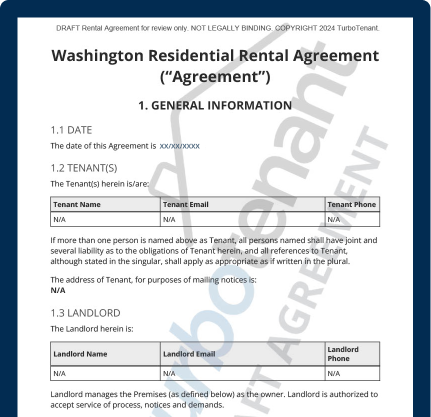
Washington Residential Lease Agreement
Current PageCreate a compliant Washington residential lease agreement in 15 minutes with TurboTenant's rental contract builder.
Washington Month-to-Month Lease Agreement
Learn MoreBuild your Washington month-to-month lease agreement in 15 minutes or less.
Room Rental Agreement Washington
Learn MoreUse a TurboTenant Washington room rental agreement template to dial in your house hacking.
Required Landlord Disclosures (12)
- Lead-based paint and hazards: Landlords who own homes built before 1978 must include a lead-based paint and hazard disclosure form and an EPA pamphlet (42 U.S.C. § 4852d).
- Copy of written rental agreement: When landlords use a written rental agreement, they must give an executed copy to each tenant who signs it. Tenants may also request 1 free replacement copy during the tenancy, so landlords should keep signed lease copies available (Wash. Rev. Code § 59.18.065).
- Fire safety and protection: Washington landlords must give new tenants a written notice or checklist about fire safety and protection systems when the lease or rental agreement is signed. For multifamily buildings, the notice or checklist should identify fire alarms, smoke detection devices, emergency notification plans, emergency relocation plans, emergency evacuation plans, smoking policies, and other required fire-safety information (Wash. Rev. Code § 59.18.060(12)(a)).
- Landlord identification: Landlords must disclose the name and address of the designated landlord, the person authorized to act for and on behalf of the landlord, and the person authorized to manage the property. Landlords may provide this disclosure by written notice or by posting a conspicuous notice on the property (Wash. Rev. Code § 59.18.060(15)).
- Mold health hazards: Washington landlords must either provide individual written notice or conspicuously post a communal notice with information from Washington’s Department of Health regarding mold health risks and how to control mold growth (Wash. Rev. Code § 59.18.060(13)).
- Security deposit checklist and lease terms: To collect a security deposit, Washington landlords must use a written rental agreement that states the terms and conditions for withholding all or part of the deposit. Landlords must also provide a signed and dated move-in checklist describing the property’s condition, cleanliness, and any existing damage. They must provide tenants a copy of the checklist (Wash. Rev. Code § 59.18.260, § 59.18.270).
- Non-refundable fees: Washington law requires that the lease agreement clearly state any non-refundable fees. If the landlord fails to provide a written rental agreement, they may be liable to the tenant for any non-refundable fees collected (Wash. Rev. Code § 59.18.285).
- Voter pamphlet and local rental information: Seattle landlords must provide tenants and prospective tenants with the city’s Renter’s Handbook, which includes voter registration information. Tacoma landlords must provide tenants with the city’s tenant information packet or summaries of rental rights and responsibilities (Sea. Mun. Code § 7.24.080, TMC 1.95).
- Occupancy: Tacoma leases must state the legal number of occupants and the number of habitable spaces in the unit (TMC 1.95).
- Notarization: In Washington, a lease that runs 1 year or less doesn’t need acknowledgment, witnesses, or seals. However, a residential lease longer than 1 year does. The landlord’s signature has to be acknowledged (notarized) for the lease to hold up for its full term. Devoid of the acknowledgment, the law treats the lease as month-to-month. Recording a lease or a memorandum of lease also calls for notarization (Wash. Rev. Code § 59.18.210).
- Flooding: For leases entered into after December 31, 2026, Washington landlords must disclose whether the rental property is located in a special flood hazard area or an area of potential flooding. The disclosure must also tell tenants that landlord insurance does not cover their personal belongings (Substitute Senate Bill 6237, Chapter 234, Laws of 2026).
- Deposit waiver fee disclosure: If a landlord offers tenants the option to pay a recurring fee instead of a security deposit, the landlord must give tenants the statutory written disclosure with any lease or renewal that includes that option. The disclosure must explain that the fee does not count as a refundable security deposit, the tenant may choose to pay the full security deposit instead, and the tenant may still owe unpaid rent, fees, or damage costs under the lease (Wash. Rev. Code § 59.18.670).
Security Deposit Regulations
Maximum security deposit amount: Washington state law does not set a general statewide limit on the amount landlords can charge for a security deposit. However, landlords must let tenants pay deposits, non-refundable fees, and last month’s rent in installments if the tenant requests it, unless the deposit and non-refundable fees total 25% or less of the first full month’s rent and the landlord does not require last month’s rent at move-in (Wash. Rev. Code § 59.18.610).
Seattle landlords cannot charge more than 1 month’s rent for the security deposit and move-in fees combined and must allow tenants to pay those costs in installments (Sea. Mun. Code § 7.24.038).
In Tacoma, total move-in costs cannot exceed 1 month’s rent (TMC 1.100.040).
Receipt of deposit: Washington law requires landlords to provide tenants with a written receipt for the security deposit and a written notice listing the name, address, and location of the financial institution or escrow agent holding the security deposit. Landlords must also notify tenants of any changes (Wash. Rev. Code § 59.18.270).
Interest: Landlords must promptly deposit all security deposits in a trust account, financial institution, or with a licensed escrow agent located in Washington. Unless the parties agree otherwise in writing, the landlord has the right to retain any accrued interest in the account (Wash. Rev. Code § 59.18.270).
Deduction tracking: When returning a security deposit, Washington landlords must provide a full written statement detailing the basis for retaining any portion of the deposit. If the landlord or their employee completed the repairs, the statement must include the time spent on repairs, the reasonable hourly rate charged, and receipts for materials or supplies. For contracted repairs, landlords must include invoices (Wash. Rev. Code § 59.18.280(1)(a)-(b)).
Returning a tenant’s security deposit: Landlords must return security deposits within 30 days after the rental agreement ends and the tenant vacates, or within 30 days after the landlord learns that the tenant abandoned the property. Landlords must include any required statement of withholdings and send the refund or statement personally, by mail, or electronically if the tenant agrees (Wash. Rev. Code § 59.18.280(1)(a)).
Landlord’s Access to Property
Advance notice: Washington landlords must give 2 days’ written notice before entering a property, except in emergencies or when providing notice is impracticable. The notice must include the date and time, or a time window, when the landlord will enter, plus a phone number the tenant can use to object to or reschedule the entry (Wash. Rev. Code § 59.18.150(6)).
Immediate access: As of 2026, Washington law allows landlords to enter a property immediately, without notice, in emergencies or if the tenant abandons the property (Wash. Rev. Code § 59.18.150(5)).
Landlord harassment: After receiving 1 written notification of improper entry, Washington landlords may be liable for up to $100 per additional entry that violates their tenant’s rights and may have to pay their tenant’s attorney fees (Wash. Rev. Code § 59.18.150(8)). Repeat violations may allow tenants to legally break their rental lease agreement under Washington’s unlawful harassment provision (§ 59.18.575(1)).
Rent Payment Laws
Grace period: In Washington, tenants have a 5-day grace period to pay rent before landlords may charge late fees. Landlords may still serve a notice to pay or vacate any time after rent becomes due (Wash. Rev. Code § 59.18.170(2)).
Late rent fees: Washington landlords may charge late fees if rent is more than 5 days past due, and the fees may begin from the first day after the rent due date. The landlord should outline late fees in the rental agreement (Wash. Rev. Code § 59.18.170(2)).
Tenant’s right to withhold rent: Washington laws allow tenants to deduct repair costs from rent in certain situations. Tenants may deduct up to 1 month’s rent if they complete qualifying repairs themselves, or up to 2 months’ rent if they hire a licensed, registered, or otherwise qualified repair worker. Tenants must follow the required notice, estimate, timing, and inspection rules before deducting repair costs (Wash. Rev. Code § 59.18.100).
Breach of Rental Agreement
Missed rent payment: Washington law allows landlords to charge late fees after the 5-day grace period (Wash. Rev. Code § 59.18.170(2)) or to issue a 14-Day Notice to Pay or Vacate after rent becomes due (§ 59.12.030(3)).
Lease violation: In response to lease violations, Washington landlords can issue a 10-Day Notice to Comply or Vacate. If the tenant has 4 or more violations in 12 months, the landlord can issue a 60-Day Notice to Quit with no option to cure (Wash. Rev. Code § 59.12.030(4), § 59.18.650(2)(n)(i)). If the tenant substantially damages the unit, causes a nuisance, or engages in unlawful activity on the premises, the landlord may issue a 3-Day Notice to Quit (§ 59.12.030(5)).
Self-help evictions: Self-help evictions are illegal in Washington, and landlords should never attempt them. Landlords must follow the legal eviction process and may not remove or exclude tenants from the property without a court order (Wash. Rev. Code § 59.18.290).
Lease abandonment: In Washington, tenants who abandon their lease early must pay the remaining rent owed for the duration of the contract or for the period it took the landlord to find a new tenant, whichever is less. Landlords must also make reasonable efforts to re-rent the unit at a fair rental value (Wash. Rev. Code § 59.18.310(1)).
Prohibited lease clauses: Washington lease agreements cannot require tenants to waive rights under the Residential Landlord-Tenant Act, authorize confession of judgment, pay unlawful attorney fees, indemnify the landlord for the landlord’s liability, give the landlord a lien on the tenant’s personal property, pay late fees within the 5-day grace period, or pay rent only through electronic means. Washington law makes prohibited lease terms unenforceable (Wash. Rev. Code § 59.18.230).
Ending a Lease
Month-to-month: Washington landlords cannot terminate a month-to-month rental lease agreement without a valid reason, like missed rent payments or lease violations. Exceptions may apply if the landlord plans to sell the rental, change its use, or have the landlord or the landlord’s family occupy it. Tenants may terminate a month-to-month lease with at least 20 days’ written notice before the end of the rental period (Wash. Rev. Code § 59.18.650, § 59.18.200).
Fixed-term: Tenants can legally break a standard lease early in Washington for several reasons, including military service relocation (Wash. Rev. Code § 59.18.220), being a victim of domestic violence, sexual assault, unlawful harassment, or stalking (§ 59.18.575), threatening behavior by another tenant or the landlord (§ 59.18.352, § 59.18.354), or the landlord’s failure to meet legal repair duties (§ 59.18.090).
Property abandonment: If a tenant abandons a property during their lease term, Washington landlords may enter and take possession of any remaining tenant property. Landlords must store the property in a reasonably secure place and provide written notice before selling or disposing of it. Property with a cumulative value of $250 or less may be sold or disposed of 7 days after notice, excluding personal papers, family pictures, and keepsakes. Property worth more than $250 may be sold or disposed of 45 days after notice (Wash. Rev. Code § 59.18.310).
Renewing a Lease
Required renewals: Washington landlords do not have to allow tenants with fixed-term leases to renew after the lease term expires in all cases. However, they may only end or refuse to continue many residential tenancies for a valid reason listed under Washington’s good-cause eviction rules. Tenants with month-to-month or other periodic leases are entitled to continue the tenancy unless the landlord has a valid reason to terminate it (Wash. Rev. Code § 59.18.650).
Required notice: As of 2026, Washington landlords may end certain fixed-term leases without cause at the end of the lease term only if they meet the statute’s requirements and give at least 60 days’ advance written notice before the lease expires (Wash. Rev. Code § 59.18.650).
For month-to-month and periodic leases, notice requirements depend on the reason for termination. For example, landlords generally must give 90 days’ notice to sell the rental unit, 90 days’ notice for landlord or family occupancy, and 120 days’ notice for demolition, substantial rehabilitation, or a change of use (§ 59.18.650, § 59.18.200).
Washington Residential Lease Agreement FAQs
Does a landlord have to provide a copy of the lease in Washington?
Yes. Washington landlords must provide 1 copy of the lease to each tenant who signed it. Tenants may also request 1 free replacement copy during the tenancy (Wash. Rev. Code § 59.18.065).
What is the grace period for rent in Washington?
Washington tenants have a 5-day grace period before landlords may charge late fees. Landlords can still enforce rent obligations, but they cannot assess late fees until the grace period has passed (Wash. Rev. Code § 59.18.170(2)).
Can a landlord refuse to renew a lease in Washington?
It depends on the lease. Washington landlords may refuse to renew certain fixed-term leases at the end of the lease term with at least 60 days’ notice if they meet the statute’s requirements. However, landlords typically cannot refuse to continue a month-to-month or other periodic lease without a valid reason (Wash. Rev. Code § 59.18.650).
Does a Washington lease need to be notarized?
Only leases longer than 1 year generally need notarization in Washington. Leases of 12 months or less do not need to be notarized to remain enforceable (Wash. Rev. Code § 59.18.210).
Can you withhold rent for repairs in Washington?
Yes, but tenants must follow Washington’s repair-and-deduct rules. Tenants may deduct up to 1 month’s rent if they complete qualifying repairs themselves, or up to 2 months’ rent if the work requires a skilled or licensed repair worker (Wash. Rev. Code § 59.18.100).