


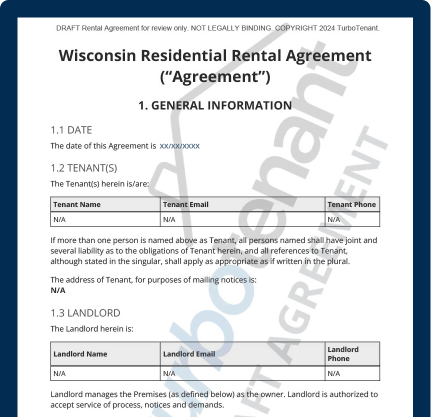
A Wisconsin lease agreement gives landlords and tenants a clear starting point before the renter moves in and begins the tenancy. This crucial contract defines the relationship between both parties, outlines non-negotiable details about the property, and explains the rights and responsibilities for everyone involved.
Lease agreements typically include the property address and physical description, the parties to the rental contract, rent details, security deposit information, and utility responsibilities. These terms help landlords and tenants get on the same page before move-in day. Create your next legally compliant contract by clicking the Create Document button above, or keep reading for important legal information.

Wisconsin Residential Lease Agreement
Current PageCreate a compliant Wisconsin lease agreement in 15 minutes with TurboTenant's rental contract builder.
Wisconsin Month-to-Month Lease Agreement
Learn MoreBuild your Wisconsin month-to-month lease agreement in 15 minutes.
Room Rental Agreement Wisconsin
Learn MoreRent your spare room with a Wisconsin room rental agreement today.
Required Landlord Disclosures (10)
In addition to signing the residential lease agreement, Wisconsin landlords must disclose certain federal- and state-mandated facts about the rental unit to the tenant, which include:
- Lead-based paint: Federal law requires landlords to disclose known lead-based paint or lead-based paint hazards in most properties built before 1978. Landlords must also provide the required lead warning statement and EPA-approved pamphlet before the tenant signs the lease (42 U.S.C. § 4852d).
- Copy of written lease and rules: Wisconsin landlords must provide tenants with a copy of any written lease and rules and regulations before accepting earnest money or a security deposit. When the landlord and tenant enter into the rental agreement, the landlord must give the tenant a copy of the signed lease and any applicable written rules (Wis. Admin. Code § ATCP 134.03).
- Security deposit check-in rights: Wisconsin landlords who accept a security deposit must notify tenants in writing that they may inspect the rental unit and report preexisting damage or defects by a stated deadline of at least 7 days after the tenancy begins. Tenants may also request a list of physical damages or defects charged to the previous tenant’s security deposit, and the landlord may require that such a request be made in writing (Wis. Admin. Code § ATCP 134.06).
- Code violations and structural defects: Before accepting a security deposit or entering into a rental agreement, Wisconsin landlords must disclose known uncorrected building or housing code violations that affect the unit or common areas and present a significant threat to health or safety. They also must disclose structural defects that present a substantial hazard or would threaten tenant health or safety if the defect remains unrepaired (Wis. Admin. Code § ATCP 134.04).
- Domestic abuse: Wisconsin residential lease agreements must include the statutory notice explaining that certain tenants who experience domestic abuse, sexual assault, or stalking may have eviction defenses or limited rights to terminate the rental agreement (Wis. Stat. § 704.14).
- Shared utilities: If a landlord does not include utility charges in rent, and the rental unit or common areas do not have separate utility meters, they must disclose how they plan to allocate charges among tenants (Wis. Admin. Code § ATCP 134.04).
- Landlord’s name and address: The lease or a separate written document must disclose the name and address of the person authorized to collect rent and manage the property, as well as the person authorized to accept service of process and other notices (Wis. Admin. Code § ATCP 134.04).
- Utilities: Before accepting a security deposit or entering into a rental agreement, landlords must disclose whether water, heat, or electricity charges are not included in the rent (Wis. Admin. Code § ATCP 134.04).
- Nonstandard rental provisions: Nonstandard rental provisions: If a Wisconsin lease allows the landlord to withhold security deposit funds for reasons not already listed under state law, the landlord must place those terms in a separate written document titled ‘NONSTANDARD RENTAL PROVISIONS.’ The landlord must identify each provision before the tenant signs or initials it (Wis. Admin. Code § ATCP 134.06).
- Promises to repair: If a Wisconsin landlord promises to repair, clean, or improve the unit before the landlord and tenant enter into the rental agreement, the landlord must put that promise in writing and state the completion date. Landlords should include any agreed pre-move-in repairs in the lease or a signed lease addendum (Wis. Admin. Code § ATCP 134.07).
Landlord’s Access to Property
Advance notice: Landlords must provide at least 12 hours’ written notice before entering a tenant’s unit. They may only enter at reasonable times and for acceptable reasons, such as inspections, repairs, or property showings (Wis. Admin. Code § ATCP 134.09(2); see also Wis. Stat. § 704.05(2)).
Immediate access: Landlords may enter without advance notice in emergencies, when the tenant allows entry on shorter notice, or when the tenant is absent, and the landlord reasonably believes entry is essential to protecting the property (Wis. Admin. Code § ATCP 134.09).
Landlord harassment: Landlords who do not comply with Wisconsin’s entry rules may face tenant complaints or legal action. Tenants should document each improper entry and review their legal options before withholding rent or trying to break the lease (Wis. Admin. Code § ATCP 134.09).
Rent Payment Laws
Grace period: Wisconsin law does not establish a mandatory grace period for late rent payments.
Late rent fees: Wisconsin landlords may charge late fees if the rental agreement specifically allows them. Landlords must apply rent prepayments to the amount of rent owed before charging a late fee, and cannot charge a fee or penalty for nonpayment of a late fee (Wis. Admin. Code § ATCP 134.09).
Tenant’s right to withhold rent: If a landlord does not make required repairs and the problem affects the tenant’s health, safety, or ability to use the unit, the tenant may qualify for rent abatement. However, Wisconsin law does not permit tenants to remain in the unit and stop paying rent entirely (Wis. Stat. § 704.07).
Breach of Rental Agreement
Missed rent payment: For leases of 1 year or less, landlords must give tenants a 5-Day Notice to Pay or Quit after missed rent payments. If the tenant misses another rent payment within 1 year after receiving a 5-day notice, the landlord may issue a 14-Day Notice to Quit and terminate the lease (Wis. Stat. § 704.17).
Lease violation: For leases of 1 year or less, landlords must usually give tenants a 5-Day Notice to Cure or Quit for lease violations. If the tenant commits another lease violation within 1 year after receiving a 5-day notice, the landlord may issue a 14-Day Notice to Quit without giving the tenant another chance to cure (Wis. Stat. § 704.17).
Self-help evictions: Wisconsin landlords cannot remove tenants through self-help eviction tactics, like changing the locks, removing doors, shutting off utilities, or removing a tenant’s belongings (Wis. Stat. § 799.40).
Lease abandonment: If the tenant breaks the lease early without a legal reason, they may still owe rent for the remaining term. That said, Wisconsin landlords must make reasonable efforts to re-rent the unit and reduce the tenant’s damages (Wis. Stat. § 704.29, Wis. Admin. Code § ATCP 134.06).
Prohibited lease clauses: Wisconsin rental agreements become void and unenforceable if they include certain prohibited clauses. Landlords should avoid lease terms that waive the landlord’s legal duties, require tenants to pay landlord attorney fees or costs in certain disputes, accelerate rent after default, allow confession of judgment, authorize eviction without judicial process, or let the landlord retaliate because a tenant contacted law enforcement, health services, or safety services (Wis. Stat. § 704.44).
Ending a Lease
Month-to-month: Landlords or tenants must provide at least 28 days’ written notice when they intend to end a month-to-month lease (Wis. Stat. § 704.19).
Fixed-term: Tenants can break a lease early and without penalty only in legally approved circumstances. Those may include entering active military duty (50 U.S.C. § 3955), landlord harassment or retaliation (Wis. Stat. § 704.45; Wis. Admin. Code § ATCP 134.09), or uninhabitable living conditions (Wis. Stat. § 704.07).
Property abandonment: If the tenant leaves personal property behind, Wisconsin landlords may presume the tenant abandoned their belongings and dispose of them (unless the landlord and tenant agreed otherwise in writing). Different rules apply to prescription medication, medical equipment, manufactured homes, mobile homes, and titled vehicles (Wis. Stat. § 704.05).
Renewing a Lease
Required renewals: Wisconsin landlords do not have to allow a tenant to renew a standard lease agreement when the lease term ends.
Required notice: For month-to-month leases, Wisconsin landlords or tenants must provide at least 28 days’ written notice before ending the tenancy. For fixed-term leases, neither party needs to give notice unless the lease says otherwise (Wis. Stat. § 704.19).
Automatic renewal clauses: If a Wisconsin residential lease includes an automatic renewal clause, the landlord must remind the tenant of that clause in writing at least 15 days, but no more than 30 days, before the tenant must give notice to avoid renewal. Without that written reminder, landlords cannot enforce the automatic renewal clause (Wis. Stat. § 704.15).
Wisconsin Residential Lease Agreement FAQs
Does a landlord have to provide a copy of the lease in Wisconsin?
Yes, Wisconsin landlords must provide tenants with a written copy of the rental agreement and any rules or regulations that apply to the tenancy (Wis. Admin. Code § ATCP 134.03).
What is the grace period for rent in Wisconsin?
Wisconsin law does not require a grace period for rent. Landlords can follow the due date stated in the lease and charge late fees if the lease allows.
Can a landlord refuse to renew a lease in Wisconsin?
Yes, Wisconsin landlords do not have to renew a lease when the term ends. For month-to-month tenancies, landlords must provide at least 28 days’ written notice before ending the agreement (Wis. Stat. § 704.19).
Does a Wisconsin lease need to be notarized?
No, Wisconsin leases do not need to be notarized to be legally valid.
Can you withhold rent for repairs in Wisconsin?
Wisconsin tenants may receive rent abatement if a landlord fails to make required repairs and the issue materially affects the tenant’s health or safety, or substantially affects the tenant’s use of the property. Tenants who stay in their rental unit cannot withhold the full rent amount (Wis. Stat. § 704.07).
Can a Wisconsin landlord add custom language to a lease?
Yes. A Wisconsin landlord can add custom language to a lease, as long as it complies with applicable laws. To do so, use TurboTenant’s custom lease agreement tool to create a PDF, downloadable template, or sample form, then adjust rent terms, smoking rules, parking details, maintenance protocols, and more.
Disclaimer: TurboTenant does not provide legal advice. This material has been prepared for informational purposes only. All users are advised to check all applicable local, state, and federal laws and consult legal counsel should questions arise.