


A New Mexico lease agreement is a legally binding contract between a landlord and tenant that defines the rules of the rental relationship. It sets legal guidelines that both parties must follow and gives the tenant important information about the rental unit.
Although landlords can simplify the leasing process in 2026 with TurboTenant’s lease generator, understanding the basics of New Mexico rental law is essential. Keep reading for a deep dive into everything you need to know about lease agreements in New Mexico.

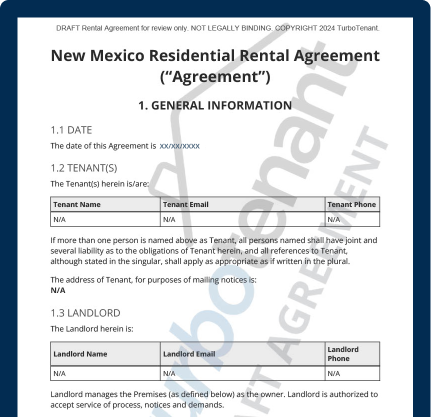
New Mexico Residential Lease Agreement
Current PageCreate a compliant New Mexico lease agreement in 15 minutes with TurboTenant's rental contract builder.
New Mexico Month-to-Month Lease Agreement
Learn MoreBuild your New Mexico month-to-month lease agreement in 15 minutes or less.
New Mexico Room Rental Agreement
Learn MoreRent your spare room with a New Mexico room rental agreement today.
Required Landlord Disclosures (5)
Both federal and state laws require landlords to provide certain information to tenants during the lease signing process. Depending on the specifics of the disclosure, landlords can include it in the New Mexico residential lease agreement or provide it as a separate document altogether. Every TurboTenant lease agreement includes these disclosures.
- Lead paint: Federal law requires landlords nationwide to disclose the presence or knowledge of lead-based paint or other lead-based hazards on any property built before 1978 (42 U.S.C. § 4852d).
- Landlord identification: New Mexico landlords must disclose, at or before the start of the tenancy, the name, address, and phone number of the person authorized to manage the premises, as well as the owner or an authorized agent for notices and service of process (N.M. Stat. Ann. § 47-8-19).
- Written rental agreement copy: New Mexico landlords must provide each tenant with a written rental agreement before occupancy begins. Add this requirement to the lease-signing disclosure section, even if the article also keeps the FAQ answer below (N.M. Stat. Ann. § 47-8-20(G)).
- Shared utilities: In multi-unit housing, tenants may request copies of certain utility bills and the calculations used to apportion common-area or submetered utility costs. Landlords may charge an administrative fee of up to $5 for each monthly request (N.M. Stat. Ann. § 47-8-20(F)).
- Copies of property rules and regulations: If a landlord wants to enforce property rules or regulations, they must give the tenant copies of all existing rules when the tenant enters into the rental agreement. Landlords must also give tenants notice of later rule changes, and those changes cannot substantially modify the original bargain (N.M. Stat. Ann. § 47-8-23).
Security Deposit Regulations
Maximum security deposit amount: For rental agreements lasting less than 1 year, New Mexico caps security deposits at 1 month’s rent. For annual rental agreements, deposits must be reasonable, and landlords must pay annual interest on any deposit that exceeds 1 month’s rent (N.M. Stat. Ann. § 47-8-18(A)).
Receipt of deposit: New Mexico landlords do not have to provide a receipt for the security deposit.
Interest: Landlords in New Mexico must pay tenants interest each year on security deposits exceeding 1 month’s rent. The interest should equal the passbook interest permitted to savings and loan associations in New Mexico by the Federal Home Loan Bank Board (N.M. Stat. Ann. § 47-8-18(A)(1)).
Deduction tracking: Landlords may deduct funds from a tenant’s security deposit to cover unpaid rent, repairs that exceed normal wear and tear, and other damages resulting from the tenant’s breach of the residential lease agreement. When returning the remaining security deposit funds, landlords must itemize the deductions and send a written list to the tenant (N.M. Stat. Ann. § 47-8-18(C)).
Returning a tenant’s security deposit: If the landlord keeps a portion of the deposit, they must provide an itemized written list of deductions and return any remaining balance within 30 days after termination of the rental agreement or the tenant’s departure, whichever occurs later (N.M. Stat. Ann. § 47-8-18(C)).
Landlord’s Access to Property
Advance notice: Landlords may enter a tenant’s unit if they provide 24 hours’ advance notice and should try to accommodate any entry-time request from the tenant (N.M. Stat. Ann. § 47-8-24(A)(1)).
Immediate access: New Mexico landlords can enter a tenant’s unit without permission only in emergencies (N.M. Stat. Ann. § 47-8-24(B)).
Landlord harassment: Landlords who repeatedly enter a tenant’s unit without proper notice may be liable for landlord harassment. Tenants may obtain a court order prohibiting the landlord from entering, recovering damages for the harassment, or terminating the rental agreement early without penalty (N.M. Stat. Ann. § 47-8-24).
Rent Payment Laws
Grace period: As of 2026, New Mexico has no mandatory grace period for late rent payments.
Late rent fees: New Mexico caps late fees at 5% of rent for each rental period in default. Landlords must calculate late fees only on rent (and not deposits, added fees, or utilities). To assess a late fee, the landlord must provide notice no later than the last day of the next rental period after the default occurred (N.M. Stat. Ann. § 47-8-15(D)).
Tenant’s right to rent abatement: If a landlord fails to fix a qualifying condition within 7 days after written notice, the tenant may abate rent under New Mexico law. The tenant may abate one-third of the prorated daily rent for each day the condition remains unresolved, or 100% of rent if the unit is uninhabitable and the tenant cannot live there because of the condition (N.M. Stat. Ann. § 47-8-27.1, 47-8-27.2).
Breach of Rental Agreement
Missed rent payment: If a tenant fails to pay rent on time, New Mexico landlords can issue a 3-Day Notice to Pay or Quit, which gives the tenant 3 days to either pay the overdue rent in full or move out (N.M. Stat. Ann. § 47-8-33(D)).
Lease violation: New Mexico landlords may issue a 7-day Notice to Cure or Quit for lease violations, giving tenants 7 days to remedy the violation. If the tenant does not correct the issue within that timeframe, the landlord can terminate the lease and pursue eviction (N.M. Stat. Ann. § 47-8-33(A)).
Self-help evictions: New Mexico prohibits self-help evictions, which occur when landlords attempt to evict a tenant without following the legal eviction process. Landlords must follow eviction procedures when attempting to remove a tenant.
Lease abandonment: If a tenant ends a lease early without proper cause, they could owe rent for the remainder of the lease. During these circumstances, New Mexico law requires landlords to mitigate damages by re-renting the unit as soon as possible. Once the landlord re-rents the unit, the previous tenant no longer owes rent payments (N.M. Stat. Ann. § 47-8-6).
Prohibited waiver clauses: New Mexico lease agreements cannot require the landlord or tenant to waive or give up legal rights or remedies. Landlords should avoid lease language that attempts to remove rights created by New Mexico landlord-tenant law (N.M. Stat. Ann. § 47-8-16).
Ending a Lease
Month-to-month: Landlords and tenants may end a standard month-to-month lease agreement in New Mexico by providing at least 30 days’ written notice (N.M. Stat. Ann. § 47-8-37).
Fixed-term: Tenants may be able to break a lease early without penalty in limited situations, such as active military duty, material landlord noncompliance, unlawful landlord entry, or other rights provided by the lease or applicable law. New Mexico also gives certain domestic violence protections in eviction cases involving alleged substantial violations.
Property abandonment: New Mexico’s rules for property left behind depend on how the tenancy ends. If the rental agreement ends by abandonment, the landlord must store the tenant’s personal property for at least 30 days and provide written notice before disposing of it. If the tenant voluntarily surrenders the unit, the landlord must store the property for at least 14 days. If the lease ends via a writ of restitution, the landlord typically has no storage obligation after 3 days following the writ’s execution (N.M. Stat. Ann. § 47-8-34.1).
Renewing a Lease
Required renewals: New Mexico landlords do not have to renew a residential lease agreement once the term expires.
Required notice: New Mexico landlords do not have to give tenants advance notice if they do not intend to renew a standard fixed-term lease agreement. However, they must provide at least 30 days’ written notice when ending a month-to-month rental lease agreement in New Mexico (N.M. Stat. Ann. § 47-8-37).
Disclaimer: TurboTenant does not provide legal advice. We prepared this material for informational purposes only. All users should check applicable local, state, and federal laws and consult legal counsel with questions.
New Mexico Residential Lease Agreement FAQs
Does a landlord have to provide a copy of the lease in New Mexico?
Yes. New Mexico landlords must provide tenants with a copy of the rental agreement before the tenancy begins (N.M. Stat. Ann. § 47-8-20(G)). Issuing the tenant a written copy of the contract helps ensure both parties understand the terms and responsibilities outlined in the lease.
What is the grace period for rent in New Mexico?
New Mexico law does not require landlords to give the tenant a grace period for late rent payments. The lease agreement generally determines any grace period or late fee policy.
Can a landlord refuse to renew a lease in New Mexico?
Yes. New Mexico landlords are not required to renew a lease once the lease term expires, unless the refusal would violate fair housing laws or other tenant protections.
Does a New Mexico lease need to be notarized?
No. New Mexico residential lease agreements do not need to be notarized to be legally enforceable. The rental contract becomes legally binding once both the landlord and tenant sign it.
Can you withhold rent for repairs in New Mexico?
In certain situations, yes. New Mexico tenants may withhold rent if a landlord fails to address conditions that materially affect health and safety or make the unit uninhabitable (N.M. Stat. Ann. § 47-8-27.1, § 47-8-27.2). That said, New Mexico law does not allow tenants to use a “repair and deduct” strategy.
Disclaimer: TurboTenant does not provide legal advice. This material has been prepared for informational purposes only. All users are advised to check all applicable local, state, and federal laws and consult legal counsel should questions arise.