


A Maine lease agreement is a legally binding contract that outlines the rights and responsibilities of landlords and tenants in Maine. This document covers the specific terms of the rental arrangement, including the tenancy duration, monthly rent, security deposit, and any disclosures required by law.
With TurboTenant’s legally compliant lease generator, landlords can create a Maine-specific lease agreement in as little as 15 minutes. Now, let’s discuss the disclosures that the lease must include.

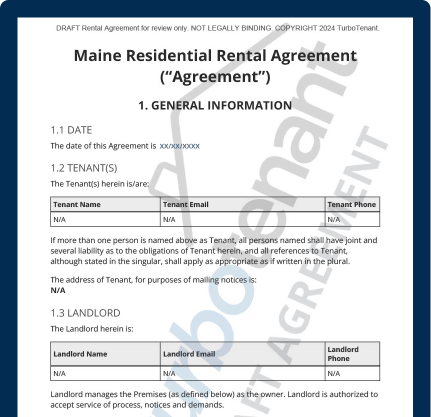
Maine Residential Lease Agreement
Current PageCreate a compliant Maine lease agreement in 15 minutes with TurboTenant's rental contract builder.
Maine Month-to-Month Lease Agreement
Learn MoreCreate your Maine month-to-month lease agreement in 15 minutes or less.
Room Rental Agreement Maine
Learn MoreRent your spare room with a Maine room rental agreement today.
Required Landlord Disclosures (10)
Both state and federal laws require landlords to disclose certain information to tenants before signing a new Maine residential lease agreement. Here’s what landlords must provide:
- Lead-based paint disclosure: Federal law requires landlords to disclose known lead-based paint and lead-based paint hazards in most homes or apartments built before 1978 (42 U.S.C. § 4852d).
- Late or returned check fee terms: Maine landlords may charge a late rent fee only if the landlord notified the tenant in writing at the time the rental agreement was entered into. The fee cannot exceed 4% of 1 month’s rent, and landlords cannot charge it until rent is 15 days late (Me. Rev. Stat. tit. 14, § 6028, tit. 14, § 6071).
- Bedbug disclosure: Maine law requires landlords to disclose bedbug infestations in their rental properties. If a rental unit has a bedbug infestation or sits next to a unit with one, the landlord must inform prospective tenants. At the tenant’s request, the landlord must also provide the date of the last bedbug inspection for the unit and any adjacent units (Me. Rev. Stat. tit. 14, § 6021-A).
- Radon disclosure: Before a tenant enters into a lease or tenancy at will agreement or pays a deposit, Maine landlords must provide the required written radon notice, including the date and results of the most recent test, whether mitigation has occurred, notice of the tenant’s right to conduct a test, and radon risk information. The disclosure form must include the tenant’s acknowledgment of receipt (Me. Rev. Stat. tit. 14, § 6030-D).
- Energy efficiency disclosure statement: Maine landlords must provide the residential energy efficiency disclosure statement to prospective tenants who will pay the unit’s utility costs and to tenants or prospective tenants who request it. Alternatively, the rental application may list known energy suppliers and state: “You have the right to obtain a 12-month history of energy consumption and the cost of that consumption from the energy supplier” (Me. Rev. Stat. tit. 14, § 6030-C).
- Total price disclosure statement: Before entering into a lease or tenancy at will agreement, Maine landlords must provide prospective tenants with a plain written disclosure that lists rent, mandatory recurring fees, optional recurring fees, utility service costs, and any other costs the tenant must pay under the agreement. Both parties must sign the disclosure and receive a copy; otherwise, the lease or tenancy at will agreement is unenforceable (Me. Rev. Stat. tit. 14, § 6030-J).
- Recurring fees: Maine landlords may charge optional recurring fees only if they provide written notice before implementing the fee. The notice must state that the tenant may opt in to the service or property feature and may stop paying the fee at any time without penalty (Me. Rev. Stat. tit. 14, § 6030-I).
- Common area utility disclosure: This disclosure applies only to rental units in which tenants must pay for common area utilities. In this case, landlords may offer compensation through reduced rent or another benefit for sharing utility costs. Landlords can also notify tenants that they will not provide compensation (Me. Rev. Stat. tit. 14, § 6024).
- Security deposit holdings disclosure: Maine landlords who collect a security deposit must provide tenants with written information about how they will hold the funds. Security deposits accepted after October 1, 1979, must be deposited in a bank or other financial institution (Me. Rev. Stat. tit. 14, § 6038).
- Smoking policy: Maine landlords must provide written notice stating whether smoking is prohibited on the premises, allowed throughout the premises, or allowed only in limited areas. If smoking is allowed only in limited areas, the notice must identify those areas, and the landlord must obtain the tenant’s written acknowledgment before the tenant enters into the contract or pays a deposit (Me. Rev. Stat. tit. 14, § 6030-E).
Security Deposit Regulations
Maximum security deposit amount: Maine landlords cannot charge more than 2 months’ rent as a security deposit, which helps protect tenants from high upfront costs (Me. Rev. Stat. tit. 14, § 6032).
Receipt of deposit: Landlords must disclose the name of the institution and account number where they keep the security deposit upon the tenant’s request, but they do not have to provide this information automatically (Me. Rev. Stat. tit. 14, § 6038).
Interest: Maine does not require landlords to pay tenants interest earned on security deposits. However, landlords must keep security deposits in a separate bank account, separate from their personal funds (Me. Rev. Stat. tit. 14, § 6038).
Deduction tracking: Maine landlords must provide a written statement itemizing any deductions from the security deposit and return any remaining funds to the tenant within 30 days after the lease ends (Me. Rev. Stat. tit. 14, § 6033).
Returning a tenant’s security deposit: Landlords must return security deposits, minus any lawful deductions, within 30 days after the Maine residential lease agreement ends (Me. Rev. Stat. tit. 14, § 6033).
Landlord’s Access to Property
Advance notice: Landlords must give tenants reasonable notice before entering a property, unless it is an emergency. Maine law generally defines reasonable notice as at least 24 hours (Me. Rev. Stat. tit. 14, § 6025).
Immediate access: Maine landlords can enter a rental property in an emergency. They may also enter if they reasonably believe an animal has been abandoned in the unit and faces an immediate risk to its health or safety (Me. Rev. Stat. tit. 14, § 6025, § 6025-A).
Landlord harassment: If a Maine landlord enters without proper notice for a non-emergency reason, the tenant may have legal remedies. A tenant can sue for actual damages or $100, whichever is greater, and may also have grounds to break the lease early without penalty (Me. Rev. Stat. tit. 14, § 6025).
Rent Payment Laws
Grace period: In Maine, landlords cannot charge a late fee until rent is 15 days past due (Me. Rev. Stat. tit. 14, § 6028).
Late rent fees: Landlords can charge a late fee of up to 4% of 1 month’s rent after the 15-day period expires. Maine law also requires landlords to disclose the late fee policy in the rental lease agreement before enforcing it (Me. Rev. Stat. tit. 14, § 6028).
Tenant’s right to withhold rent: Maine law allows tenants to repair and deduct by paying for certain necessary repairs themselves and then deducting that amount from rent. Tenants must follow the required notice and repair process before using this remedy (Me. Rev. Stat. tit. 14, § 6026).
Breach of Rental Agreement
Missed rent payment: Maine landlords may attempt to collect the rent plus a late fee if a tenant misses a payment. If rent remains unpaid and the tenant is at least 7 days behind, the landlord can issue a written 7-Day Notice to Quit as the first step in the Maine eviction process (Me. Rev. Stat. tit. 14, § 6002).
Lease violation: Landlords can evict tenants for certain lease violations in Maine. They must provide a written 7-Day Notice to Quit stating the specific reason for termination and giving the tenant 7 days to vacate the rental property (Me. Rev. Stat. tit. 14, § 6002).
Self-help evictions: Landlords must follow the legal eviction process instead of attempting lockouts, utility shutoffs, or other actions that remove a tenant without a court order. Self-help evictions are not legal in Maine (Me. Rev. Stat. tit. 14, § 6014).
Lease abandonment: Tenants who break their lease early may remain liable for unpaid rent and damages. Landlords, however, must make reasonable efforts to re-rent the unit and reduce the tenant’s remaining rent liability (Me. Rev. Stat. tit. 14, § 6010-A).
Unfair lease provisions: Maine landlords should remove any prohibited lease terms before signing. Unenforceable provisions include certain landlord liability waivers, tenant legal fee clauses, tenant property liens, required admissions that lease terms are fair, prohibited lease-ending fees, and prohibited recurring fees (Me. Rev. Stat. Ann. tit. 14, § 6030).
Ending a Lease
Month-to-month: Maine landlords and tenants must give at least 30 days’ written notice to end a month-to-month rental agreement (Me. Rev. Stat. tit. 14, § 6002).
Fixed-term: Tenants can legally terminate a fixed-term standard lease early in certain situations, such as military service, domestic violence, or a substantial breach of the lease or rental agreement (Me. Rev. Stat. tit. 14, § 6001).
Property abandonment: Maine landlords must store abandoned items safely and mail a written notice containing an itemized list of everything left behind. The tenant then has 7 days to respond and claim the property. If they don’t respond within 7 days, the landlord may dispose of it. If the tenant does respond, the landlord must store the property for at least 14 days after the landlord sent the notice (Me. Rev. Stat. tit. 14, § 6013).
Renewing a Lease
Required renewals: Landlords are not required to allow tenants to renew standard fixed-term lease agreements in Maine. If the lease ends on a specific date, the tenancy generally ends on that date unless the landlord and tenant agree to renew or extend it.
Required notice: Maine requires at least 30 days’ written notice to terminate a tenancy at will, including many month-to-month rental agreements. However, landlords may use a shorter 7-day notice in certain cases, which include unpaid rent, substantial property damage, nuisance behavior, or other qualifying lease violations (Me. Rev. Stat. tit. 14, § 6002).
Maine Residential Lease Agreement FAQs
Does a landlord have to provide a copy of the lease in Maine?
Maine law does not appear to require every standard residential landlord to provide a signed copy of the lease, though both parties should keep one for their records. A signed copy helps confirm the rent amount, lease term, fees, disclosures, and other responsibilities.
What is the grace period for rent in Maine?
Maine allows a 15-day grace period before landlords can charge a late rent fee. After that window, landlords can charge up to 4% of 1 month’s rent, as long as the lease or rental agreement discloses the fee in writing (Me. Rev. Stat. tit. 14, § 6028).
Can a landlord refuse to renew a lease in Maine?
Yes, landlords can refuse to renew a standard fixed-term lease agreement in Maine. For tenancies at will, including many month-to-month arrangements, either party typically must give at least 30 days’ written notice to end the tenancy (Me. Rev. Stat. tit. 14, § 6002).
Does a Maine lease need to be notarized?
No. A lease in Maine does not need to be notarized to be legally binding. In most cases, the lease becomes enforceable once both parties have reviewed, agreed to, and signed the form.
Can you withhold rent for repairs in Maine?
Yes, but tenants must follow Maine’s repair-and-deduct process. Tenants may pay for certain necessary minor repairs and deduct the cost from rent after giving proper notice and meeting the statute’s requirements (Me. Rev. Stat. tit. 14, § 6026).
Disclaimer: TurboTenant does not provide legal advice. This material has been prepared for informational purposes only. All users are advised to check all applicable local, state, and federal laws and consult legal counsel should questions arise.