


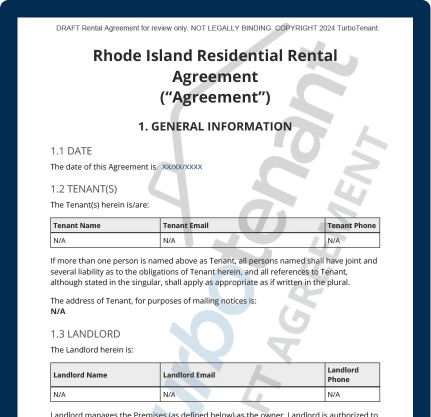
A Rhode Island residential lease agreement is a contract that outlines a rental arrangement between a tenant and a landlord. Put simply, lease agreements outline the conditions under which tenants can stay at the property in exchange for monthly rent.
It’ll include important details like the tenancy’s start and end dates, the monthly rent, the security deposit amount, and more. While we encourage landlords to use TurboTenant’s lease builder to create downloadable, legally compliant documents, we also recommend that landlords understand the key details involved in creating these essential rental contracts.

Rhode Island Residential Lease Agreement
Current PageCreate a compliant Rhode Island lease agreement in 15 minutes with TurboTenant's rental contract builder.
Rhode Island Month-to-Month Lease Agreement
Learn MoreCreate a Rhode Island month-to-month lease agreement in 15 minutes or less.
Room Rental Agreement Rhode Island
Learn MoreRent your spare room with a Rhode Island room rental agreement today.
Required Landlord Disclosures (8)
Tenants in Rhode Island must sign and/or acknowledge several forms alongside the residential lease agreement. These additional documents, known as disclosures, alert tenants to potential health and safety hazards on the property and inform tenants who to contact for maintenance and other issues.
Rhode Island has eight required landlord disclosures:
- Lead paint: Federal law requires landlords to inform tenants of any known lead-based paint or lead-based paint hazards in properties constructed before 1978 (42 U.S.C. § 4852d).
- State lead hazard information: Property owners of pre-1978 rental dwellings that do not qualify for an exemption must provide tenants with basic lead hazard control information, a copy of the independent clearance inspection, and information about how to report deteriorating conditions that may create lead hazards (R.I. Gen. Laws § 42-128.1-8(a)(4)).
- Landlord identification: Rhode Island landlords or their authorized agents must disclose, in writing, the name, address, and phone number of the person authorized to manage the premises, and the name and address of the owner, or the person authorized to act for the owner. Landlords must provide this information at or before the start of the tenancy and keep it current (R.I. Gen. Laws § 34-18-20(a)).
- Rental rules and regulations: Rhode Island landlords may include property rules in the lease or attach them to it, but they must give tenants notice of those rules when the tenant enters into the lease. Any later rule that substantially changes the tenant’s bargain requires the tenant’s written consent (R.I. Gen. Laws § 34-18-25).
- Housing code violation: Rhode Island landlords must give each affected residential tenant a copy of the housing code violation notice within 30 days of receiving it, unless the landlord corrects all violations within that period. Before entering a residential rental agreement, landlords must also tell prospective tenants about any outstanding minimum housing code violations affecting the building (R.I. Gen. Laws § 34-18-22.1)
- Non-resident landlord notice: A non-resident Rhode Island landlord must designate and continuously maintain a Rhode Island resident agent or authorized corporation for service of process, notices, and demands. The written designation must include the agent’s name and address and the street address of each assigned property, and the landlord must file it with the Rhode Island Secretary of State and the clerk of the city or town where the unit sits (R.I. Gen. Laws 34-18-22.3)
- Fees, utilities, and renters insurance: Landlords must disclose any fees beyond rent in the lease, state which utility costs are included in rent and which the tenant must pay, and disclose any renters insurance requirement in writing. Rhode Island also prohibits convenience fees on rent payments (R.I. Gen. Laws § 34-18-15).
- General liability insurance declaration page: Rhode Island landlords must maintain at least $100,000 in general liability insurance for injuries on the premises caused by the landlord’s negligence. The landlord must provide the tenant with a copy of the insurance declaration page with the written lease at the beginning of the tenancy and provide a new copy at each policy renewal (R.I. Gen. Laws § 34-18-22(a)(7)).
Security Deposit Regulations
Maximum security deposit amount: Rhode Island security deposits cannot exceed 1 month’s rent (R.I. Gen. Laws § 34-18-19(a)).
Receipt of deposit: Landlords in Rhode Island are not required to provide tenants with a security deposit receipt.
Deduction tracking: After a standard lease agreement ends, Rhode Island landlords have 20 days to send tenants a list of expenses that exceed normal wear and tear, with receipts, for deductions they make from the tenant’s security deposit (R.I. Gen. Laws § 34-18-19(b)).
Returning a tenant’s security deposit: The landlord must return the security deposit (less any qualifying deductions) to the tenant within 20 days after the tenant moves out (R.I. Gen. Laws § 34-18-19(b)).
Landlord’s Access to Property
Advance notice: Rhode Island landlords must give 2 days’ notice before entering a property for maintenance, inspections, showings, and other general purposes (R.I. Gen. Laws § 34-18-26(c)).
Immediate access: Landlords do not need to provide notice to enter the property in an emergency. The same rule applies if the tenant is away from the property for more than 7 days and something on the property needs attention (R.I. Gen. Laws § 34-18-26(b)).
Landlord harassment: Under Rhode Island’s landlord-tenant laws, landlords who do not provide adequate notice before entering a dwelling unit may be held liable for harassment. Repeat offenses could allow tenants to break their lease early without penalty (R.I. Gen. Laws § 34-18-26(c)).
Rent Payment Laws
Grace period: Tenants have a 15-day grace period to pay overdue rent in Rhode Island (R.I. Gen. Laws § 34-18-35(a)).
Late rent fees: Since there is no state law regarding late fees, landlords may charge them at their discretion, provided they outline the charges in the Rhode Island residential lease agreement.
Tenant’s right to withhold rent: In Rhode Island, tenants have the right to withhold rent payments if the landlord does not take care of an essential repair service valued at $500 or less. To do so, they must notify the landlord in writing that they will handle the repair and request reimbursement if the issue remains unaddressed within 20 days. The tenant must keep an itemized list of expenses to deduct them from the rent (R.I. Gen. Laws § 34-18-30(a)).
Breach of Rental Agreement
Missed rent payment: The landlord may serve the tenant with a 5-Day Notice to Quit if rent goes unpaid after Rhode Island’s 15-day grace period expires (R.I. Gen. Laws § 34-18-35(a)).
Lease violation: Rhode Island landlords can send tenants a written notice of a lease violation, stating that the tenant must correct the breach within 20 days, or the rental agreement will end (R.I. Gen. Laws § 34-18-36(a)).
Self-help evictions: Rhode Island law strictly prohibits self-help evictions, such as utility shutoffs and lockouts (R.I. Gen. Laws § 34-18-44).
Lease abandonment: A Rhode Island tenant who moves out early may be held responsible for paying rent for the remainder of the original lease term or until the landlord finds a new tenant, whichever occurs first (R.I. Gen. Laws § 34-18-40).
Prohibited lease provisions: Rhode Island lease agreements cannot require tenants to waive rights under the Residential Landlord and Tenant Act, authorize confession of judgment, pay attorney’s fees in a way that conflicts with the Act, or release or indemnify the landlord from legal liability. Landlords who knowingly include prohibited provisions may owe actual damages, up to 3 months’ rent, and reasonable attorney’s fees (R.I. Gen. Laws § 34-18-17).
Ending a Lease
Month-to-month: Landlords and tenants must provide a minimum of 30 days’ written notice to terminate a month-to-month rental lease agreement in Rhode Island (R.I. Gen. Laws § 34-18-37(b)).
Fixed-term: Tenants can break a Rhode Island residential lease agreement early if they are 65+ and have been admitted into an assisted living facility, are joining the military, or have received military orders (R.I. Gen. Laws § 34-18-15).
Property abandonment: If a tenant leaves personal property behind, the landlord must relocate and store it in a safe location and charge the tenant for transportation and storage fees (R.I. Gen. Laws § 34-18-50).
Renewing a Lease
Required renewals: Landlords are not required to allow tenants to renew their rental lease agreements in Rhode Island. However, fixed-term leases of 1 year or more generally convert to a month-to-month lease after the initial lease term terminates, unless the landlord provides 3 months’ notice of another arrangement (R.I. Gen. Laws § 34-18-37(c)).
Required notice: Rhode Island landlords must give 30 days’ notice if they choose not to renew a month-to-month lease or 3 months’ notice for a fixed-term lease that’s at least 1 year long (R.I. Gen. Laws § 34-18-37).
Rent increase notice: Rhode Island landlords must give tenants at least 60 days’ written notice before a rent increase takes effect. For month-to-month tenants over age 62, landlords must give at least 120 days’ written notice before raising rent (R.I. Gen. Laws § 34-18-16.1).
Rhode Island Residential Lease Agreement FAQs
Does a landlord have to provide a copy of the lease in Rhode Island?
Rhode Island landlords should provide tenants with a signed copy of the lease, though it’s not required by law. State law also requires landlords to provide the general liability insurance declaration page with the written lease at the beginning of the tenancy (R.I. Gen. Laws § 34-18-22(a)).
What is the grace period for rent in Rhode Island?
Rhode Island provides tenants a 15-day grace period before the landlord may proceed with a 5-day demand process for unpaid rent (R.I. Gen. Laws § 34-18-35(a)).
Can a landlord refuse to renew a lease in Rhode Island?
Yes. A landlord can legally choose not to renew a lease in Rhode Island when the lease term ends, unless the lease states otherwise.
Does a Rhode Island lease need to be notarized?
No. Rhode Island leases do not need to be notarized. They become legally binding once both the landlord and the tenant sign the agreement.
Can you withhold rent for repairs in Rhode Island?
Yes, but only in limited situations. After giving the landlord notice, waiting the required time, and sending an itemized statement, a tenant may repair the issue and deduct the cost from rent if the other statutory conditions are met (R.I. Gen. Laws § 34-18-30(a)).
Disclaimer: TurboTenant does not provide legal advice. This material has been prepared for informational purposes only. All users are advised to check all applicable local, state, and federal laws and consult legal counsel should questions arise.