


A Vermont lease agreement establishes a rental arrangement between a landlord and tenant and should clearly outline the expectations for all parties. Because signed leases are legally binding, they should contain the necessary information to define the property’s rules, terms, and responsibilities.
Consider using TurboTenant’s lease agreement builder to create state-specific contracts quickly. You can review each section, add property-specific details, and adjust the agreement to match your rental policies. And if you want to learn more about rental contracts in the Green Mountain State, here’s everything you need to know.

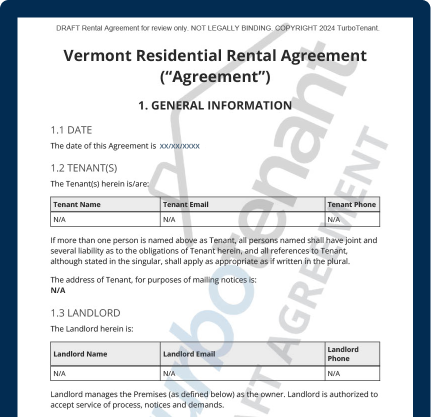
Vermont Residential Lease Agreement
Current PageCreate a compliant Vermont lease agreement in 15 minutes with TurboTenant's rental contract builder.
Vermont Month-to-Month Lease Agreement
Learn MoreBuild your Vermont month-to-month lease agreement in 15 minutes or less.
Room Rental Agreement Vermont
Learn MoreRent your spare room with a Vermont room rental agreement today.
Required Landlord Disclosures (2)
At lease signing, landlords in Vermont must disclose specific information about the property to tenants. The following disclosures are legally mandated and provide tenants with additional information about the rental property:
- Lead paint: Federal law requires landlords to disclose any knowledge of lead-based paint or lead-based paint hazards on all units built before 1978 (42 U.S.C. § 4852d).
- Flood hazard notice: Vermont landlords must disclose whether any portion of the premises for rent is located within a FEMA-mapped special flood hazard area. Landlords must provide this notice on the day of or before execution of the lease in a separate written document in the method prescribed by the Department of Housing and Community Development (Vt. Stat. Ann. tit. 9, § 4466).
Security Deposit Regulations
Maximum security deposit amount: Vermont does not currently set a statewide limit on security deposits. However, local rules may apply, so landlords should check municipal requirements before collecting a deposit (Vt. Stat. Ann tit. 9, § 4461).
Receipt of deposit: Vermont law does not require landlords to provide a receipt when they accept a security deposit.
Interest: Vermont does not require landlords statewide to pay tenants interest on security deposits. However, towns and municipalities may adopt security deposit ordinances that address interest (Vt. Stat. Ann. tit. 9, § 4461(g)).
Deduction tracking: Landlords may withhold all or part of the security deposit for unpaid rent; damage beyond normal wear and tear; unpaid utility or other charges the tenant owed directly to the landlord or a utility; and expenses required to remove abandoned property. The landlord must return the remaining deposit with a written statement that itemizes any deductions (Vt. Stat. Ann. tit. 9, § 4461(b-c)).
Returning a tenant’s security deposit: Vermont landlords must return the security deposit and any written deduction statement within 14 days after the landlord discovers that the tenant vacated or abandoned the unit, or within 14 days after the tenant’s move-out date if the landlord received notice of that date. For seasonal rentals not intended as a primary residence, landlords have 60 days (Vt. Stat. Ann. tit. 9, § 4461(c)).
Landlord’s Access to Property
Advance notice: Landlords must give tenants at least 48 hours’ notice before entering the unit and may enter only between 9 am and 9 pm for specific reasons, including inspections, repairs, agreed services, or showings (Vt. Stat. Ann. tit. 9, § 4460(b)).
Immediate access: Landlords in Vermont may enter a property without proper notice when they believe there is imminent danger to a person or the property (Vt. Stat. Ann. tit. 9, § 4460(c)).
Landlord harassment: Landlords who repeatedly enter a tenant’s unit without consent, proper notice, or a lawful reason may violate Vermont’s access rules. Tenants may be able to seek legal remedies to stop the behavior, depending on the facts of the situation (Vt. Stat. Ann. tit. 9, § 4460).
Rent Payment Laws
Grace period: Vermont law has no mandatory grace period for rent payments.
Late rent fees: Vermont law does not set a specific statewide late-fee amount or a mandatory grace period for residential leases. Landlords who charge a late fee should state the amount and timing clearly in the lease and keep the fee reasonable rather than punitive.
Tenant’s right to withhold rent: If a landlord fails to meet habitability obligations after actual notice and does not make repairs within a reasonable time, and the issue materially affects health and safety, the tenant may withhold rent, seek injunctive relief, recover damages, or terminate the rental agreement on reasonable notice (Vt. Stat. Ann. tit. 9, § 4458).
Repair and deduct: If a landlord fails to repair a minor defect within 30 days after notice, the tenant may repair it and deduct the actual and reasonable cost from rent, up to one-half of 1 month’s rent. The tenant must give the landlord actual notice of the repair cost when deducting it from rent” (Vt. Stat. Ann. tit. 9, § 4459).
Breach of Rental Agreement
Missed rent payment: Once a tenant misses a rent payment, landlords may issue a 14-Day Notice to Pay or Quit. The rental agreement will not terminate if the tenant pays the rent due through the end of the rental period (Vt. Stat. Ann. tit. 9, § 4467(a)).
Lease violation: Vermont landlords can issue a 30-Day Notice to Quit if the tenant violates a material term of the residential lease agreement or an obligation under Vermont law. Landlords in Vermont are not required to give the tenant a chance to cure the violation (Vt. Stat. Ann. tit. 9, § 4467(b)(1)).
Self-help evictions: Landlords should never attempt self-help evictions by removing the tenant without following the legal eviction process. Vermont law prohibits landlords from denying a tenant access to the rental unit or the tenant’s property except through a proper judicial process.
Lease abandonment: Tenants who end a Vermont lease agreement early without proper cause may remain liable for rent until the term expires. However, if the landlord re-rents the unit before the end of the term, the original rental agreement terminates on the date the new tenancy begins (Vt. Stat. Ann. tit. 9, § 4462(a)).
Habitability waiver: Vermont lease agreements cannot require tenants to waive the implied warranty of habitability. Any clause that attempts to waive this protection violates public policy and remains unenforceable and void (Vt. Stat. Ann. tit. 9, § 4457).
Prohibited lease clauses: Vermont rental agreements cannot include terms that attempt to avoid the landlord or tenant obligations and remedies established by Vermont’s residential rental agreement laws. Landlords should remove any clause that waives statutory tenant protections, limits required remedies, or otherwise tries to contract around Chapter 137 (Vt. Stat. Ann. tit. 9, § 4454).
Ending a Lease
Month-to-month: Whether there’s a no-cause termination notice changes the notice a landlord must provide. Under a written standard residential lease agreement, landlords must provide 30 days’ notice (for tenancies of 2 years or less) or 60 days’ notice (for tenancies of more than 2 years) before the end of the term. With no written agreement (oral or month-to-month), landlords must provide 60 days’ notice (tenancies of 2 years or less) or 90 days (more than two years) (Vt. Stat. Ann. tit. 9, § 4467).
Fixed-term: Tenants may end a rental lease agreement in Vermont early, without penalty, if they meet a qualifying condition. Legal reasons to break a lease may include the tenant entering active military duty, uninhabitable living conditions, landlord harassment, or domestic violence.
Property abandonment: Vermont landlords must give tenants written notice of their intent to dispose of property left behind after the tenant abandons the unit. The landlord must store the property in a safe, dry, secure location at the tenant’s expense. If the tenant does not claim the property and pay reasonable storage and related costs within 60 days after the notice, it becomes the landlord’s property (Vt. Stat. Ann. tit. 9, § 4462).
Renewing a Lease
Required renewals: Vermont landlords are not legally required to offer a new fixed-term lease when the original term ends.
Required notice: If a Vermont landlord wants to terminate a tenancy for no cause under a written rental agreement, they must give at least 30 days’ notice before the end of the stated lease term if the tenancy has lasted 2 years or less, or at least 60 days’ notice before the end of the stated lease term if the tenancy has lasted more than 2 years (Vt. Stat. Ann. tit. 9, § 4467).
Vermont Residential Lease Agreement FAQs
Does a landlord have to provide a copy of the lease in Vermont?
Vermont law does not require landlords to provide tenants with a copy of the residential lease agreement. Still, landlords should give tenants a signed copy so both sides can check the same rent terms, property rules, and lease responsibilities.
What is the grace period for rent in Vermont?
Vermont law does not require a mandatory grace period for rent. Rent is due on the date listed in the lease unless the rental agreement gives the tenant extra time to pay.
Can a landlord refuse to renew a lease in Vermont?
Vermont landlords do not have to renew a fixed-term lease once the original term ends unless the lease says otherwise. For periodic tenancies, landlords must follow Vermont’s required notice rules before ending the tenancy (Vt. Stat. Ann. tit. 9, § 4467).
Does a Vermont lease need to be notarized?
Vermont residential leases do not need to be notarized. Once both parties sign the lease, the agreement can bind the landlord and tenant to its terms.
Can you withhold rent for repairs in Vermont?
Vermont tenants may have remedies when a landlord fails to make repairs that materially affect health and safety after receiving notice. Depending on the issue, tenants may withhold rent, seek a court order, recover damages, repair and deduct for minor defects, or terminate the lease under Vermont law (Vt. Stat. Ann. tit. 9, § 4458, § 4459).
Disclaimer: TurboTenant does not provide legal advice. This material has been prepared for informational purposes only. All users are advised to check all applicable local, state, and federal laws and consult legal counsel should questions arise.